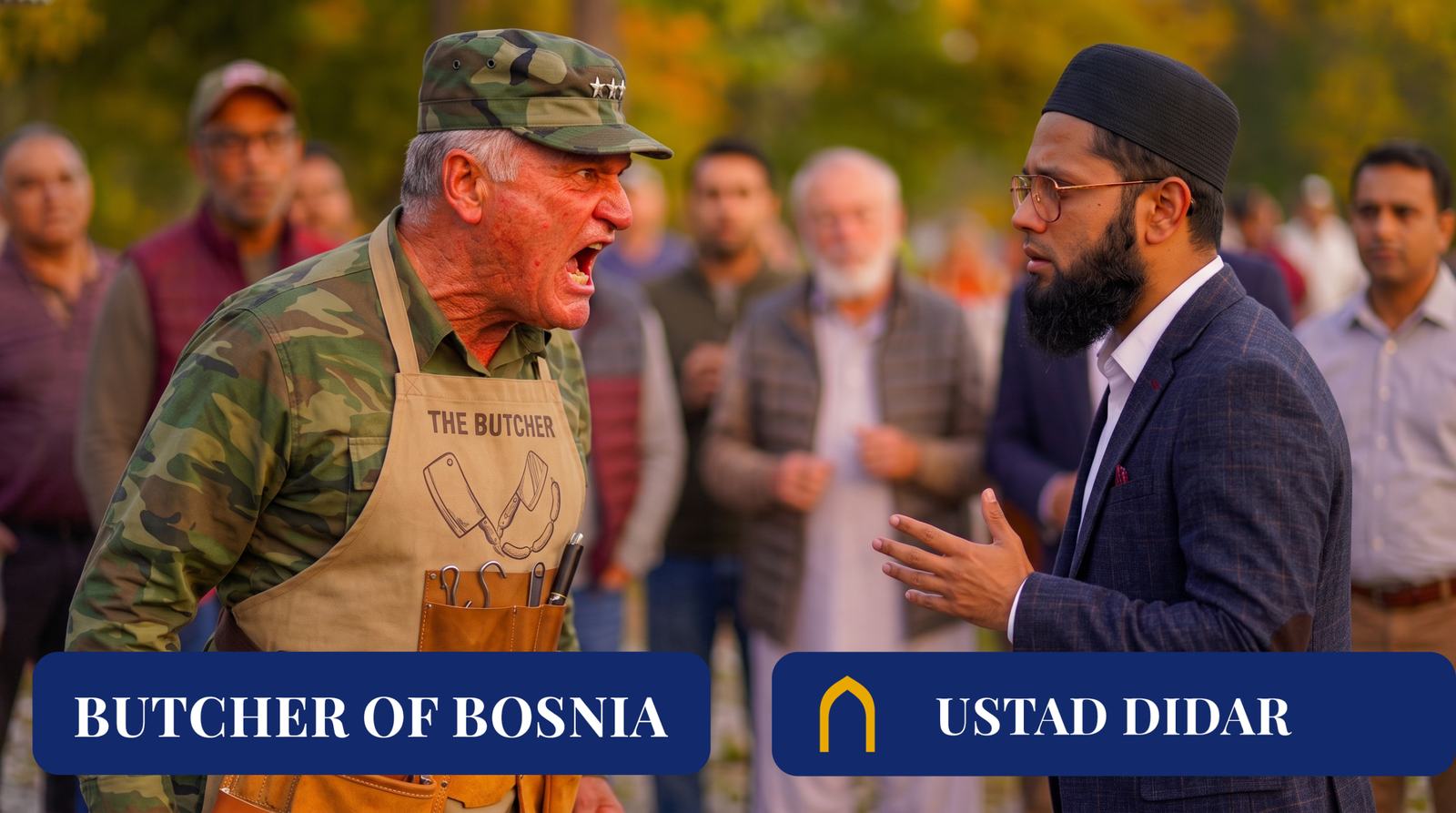
A reflection from a recent Jummah khutbah in Rainham on the history of the Bosnian genocide, and what it teaches Muslims about identity, community, and vigilance today
In August, news broke that Ratko Mladić — one of the central figures behind the Bosnian genocide, a man responsible for the worst atrocity in Europe since the Second World War — had died. The news reached our Friday khutbah speaker while he happened to be standing in Sarajevo itself. That coincidence became the starting point for a Jummah khutbah that walked through the full history of Bosnia’s Muslim community: how it began, how it was nearly erased, and what it teaches Muslims living in the UK today.
Many people alive today have never heard of the Bosnian genocide. It didn’t happen a hundred years ago, in a distant part of the world. It happened roughly thirty years ago, two and a half hours from London by plane, in the heart of Europe. This is its story, and the lesson drawn from it.
How Bosnia Became a Muslim Land — Without a Single Forced Conversion
Bosnian Muslims were never foreign to Bosnia. They were, and are, ethnically European: the same skin colour, the same language, the same heritage as their Christian and Catholic neighbours. The difference was faith, and even that arrived gradually and peacefully.
In 1463, the Ottomans brought the Balkans into their empire. Over the following centuries, local people encountered Islam and, seeing what it offered, chose to embrace it — no forced conversions, no coercion. Masjids were built. Madrasas opened. A Muslim community took root that was, in every visible way, thoroughly European.
What Happened Under Tito: Losing an Identity One Generation at a Time
After the Second World War, Yugoslavia became a communist state under Tito, and life for practising Muslims changed sharply. Sharia courts, which had handled marriage, divorce, and inheritance, were abolished. Waqf property that funded mosques and schools was nationalised. Maktabs, madrasas, and Sufi lodges were closed down.
To practise Islam openly became something to hide. Wearing visible signs of being Muslim could see you labelled an extremist and shut out of jobs — teaching, medicine, anything involving the public. Many people changed their names and presented themselves as non-Muslim simply to make a living.
By the second or third generation, many Bosnian Muslims had become “Muslim” in name only — disconnected from the religious practice their grandparents had quietly preserved under pressure. This matters, because it shaped who was actually living in Bosnia when the violence began: a community that was, by any outward measure, deeply assimilated into wider Yugoslav society.
How Hatred Builds: The Pattern Before the Genocide
The khutbah was careful to frame this next part as a historical pattern to learn from, not a comment on any single political debate happening today. But the pattern itself is worth understanding.
Genocide, as the khutbah put it, does not happen overnight. It tends to follow a sequence: an economic crisis creates hardship and anxiety; political and media rhetoric then shifts toward blaming a minority group for that hardship; and language about “purifying” or “reclaiming” the land for the majority starts to spread. Once dehumanising language becomes normalised, the ground has been prepared for far worse.
This is offered as a warning to stay alert to how this kind of rhetoric builds momentum — not as an accusation against any particular contemporary movement or policy.
The Siege of Sarajevo and the Bosnian Genocide (1992–1995)
When Yugoslavia broke apart in the early 1990s and Bosnia moved toward independence, war followed quickly. Sarajevo, the capital and a majority-Muslim city, was surrounded by Serb forces and placed under siege for four years — the longest siege of a capital city in modern history. Snipers were stationed in the surrounding hills; residents lived with signs warning them which streets were in sniper range. Families had to decide, day by day, who would risk going out for food.
Beyond the killing, there was a deliberate effort to erase evidence that Muslims had ever lived in these towns at all. Mosques were destroyed systematically — if a city had twenty mosques, all twenty were demolished. Libraries holding Islamic literature were burned. Property deeds, birth certificates, and other documentation proving Muslim residency were destroyed. Torture camps were established across the country, and mass killings — sometimes a thousand people at a time — were carried out and hidden in mass graves, later dug up and reburied elsewhere to escape detection by the international community. Even today, families continue to bury the recovered remains of loved ones, sometimes one bone at a time, found kilometres apart.
Srebrenica: A “Safe Area” That Wasn’t
In 1993, the United Nations declared the town of Srebrenica a “safe area.” Muslims fleeing violence elsewhere in Bosnia crammed in, swelling the population from around 9,000 to roughly 60,000, sheltering in factories, schools, and warehouses.
It wasn’t safe. In March 1995, a government directive was issued with the explicit aim of making life in Srebrenica unbearable. The following July, the order came to exterminate the Muslim population there — kill them or expel them. Roughly 30,000 fled toward the town of Potočari, while another group of around 20,000 tried to walk to safety through the forest toward Tuzla — a route still walked every year in a memorial peace march. Within 48 hours in Potočari, around 8,500 Muslim men and boys were killed after being separated by gender and put onto buses. Among the accounts documented since is that of a father calling his hiding son out into the open, telling him it was safe — both were killed within days. It would be ten years before their remains were recovered from a mass grave.
The Lesson for Muslims Today: Build Your Identity Before It’s Built for You
The central point of the khutbah was this: the Bosnian Muslims who were killed were, by that point, some of the most assimilated Muslims imaginable — European in language, appearance, and culture, many practising very little of their faith at all. That assimilation did not protect them. Having the label “Muslim” was enough.
The lesson drawn is not a call to isolate from wider society, but the opposite: as Muslims, if we don’t define our own identity, it will be defined for us by others — and often not kindly. That means being visibly, confidently Muslim in good character, so that when times get hard, the people around us already know who we are and stand up for us, rather than being told who we are by hostile voices.
What This Means for Us in Rainham
The khutbah closed with practical guidance rather than despair. Know your voting rights and use them. Build genuine relationships with local MPs and councillors before you need them. Let good character — the akhlaq the Prophet ﷺ exemplified — be what your neighbours associate with Muslims, so that when hostility is stirred up by politicians or the media, the people who actually know you speak up in your defence.
And, most practically: get involved in the everyday work of community life. Food banks. Soup kitchens. Helping neighbours regardless of faith. Opening the masjid’s doors to the wider community, so people can see for themselves where Islam actually stands.
This is exactly the spirit behind what we’re building in Rainham — a Muslim community that is rooted, visible, and genuinely of service to everyone around it, not just to itself.
🕌 Join us for Jummah prayer in Rainham — help us build a permanent home for the Muslim community here.
📍 rainhammercy.com
Frequently Asked Questions
What was the Bosnian genocide?
The Bosnian genocide refers to the mass killing of Bosnian Muslims (Bosniaks) during the Bosnian War of 1992–1995, including the destruction of mosques, cultural heritage, and communities, and culminating in the July 1995 massacre at Srebrenica, where roughly 8,500 Muslim men and boys were killed in under 48 hours. It is recognised as the worst atrocity in Europe since the Second World War.
Who was Ratko Mladić?
Ratko Mladić was a Bosnian Serb military commander, often referred to as “the butcher of Bosnia,” who was later convicted of genocide and crimes against humanity for his role in the Srebrenica massacre and the siege of Sarajevo. His death in August 2026 prompted this khutbah’s reflection on the genocide’s history.
What happened at Srebrenica?
Srebrenica was a town declared a UN “safe area” in 1993 that became a refuge for tens of thousands of fleeing Muslims. In July 1995, Serb forces overran the town and killed thousands of Muslim men and boys within days, in what is recognised internationally as an act of genocide.
Does this khutbah blame a specific political party or policy today?
No. The khutbah describes a general historical pattern — economic hardship followed by rhetoric that blames and dehumanises a minority — as a warning to stay alert to how such language builds over time. It is not directed at any single contemporary political debate.
What’s the main lesson from this khutbah?
That a Muslim identity left undefined by the community itself will eventually be defined by others. The response isn’t isolation, but visible good character, genuine community involvement, and political and civic engagement — knowing your rights, building relationships with local representatives, and serving neighbours of every background.
Where can I hear more khutbahs like this?
Join us for Jummah at our Rainham community — visit rainhammercy.com for prayer times, updates, and how to get involved with the RAHMA Rainham project.
