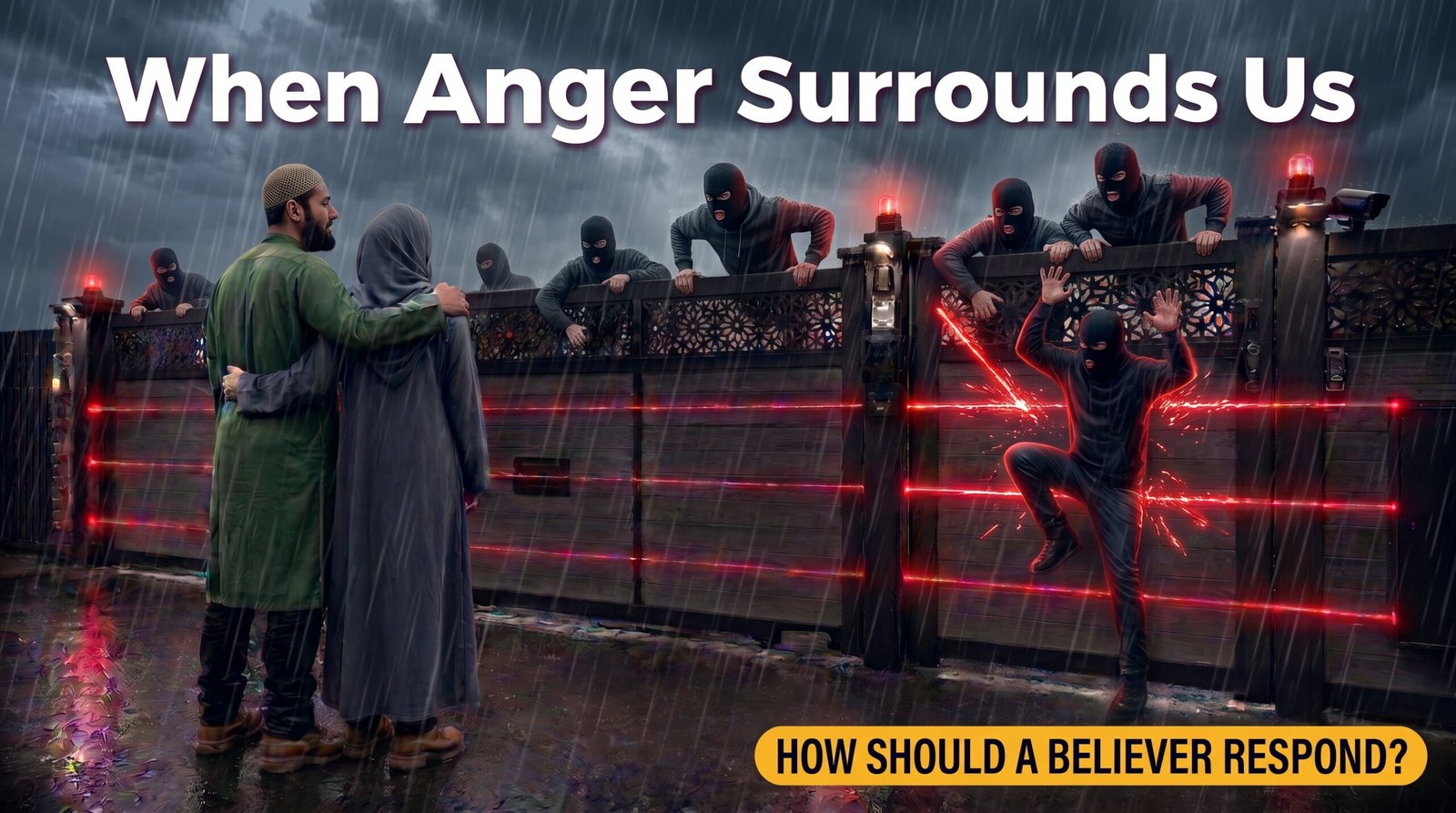
A reflection from a recent Jummah khutbah in Rainham on justice, leadership, and what Islam actually asks of us in the face of hostility
It’s not an abstract question anymore. Mosques have been attacked. Public protests have targeted Muslim communities. Recorded anti-Muslim hate incidents have climbed sharply in the past year alone. A recent khutbah here in Rainham opened with the question sitting underneath all of it: when hatred surrounds us, how are we actually supposed to respond?
Before going further, it’s worth being clear about what this khutbah was not about. It wasn’t a comment on immigration policy, or on any specific political debate — the khutbah explicitly set that question aside. What it addressed instead is something more foundational: what does the Qur’an actually command a believer to do when faced with hatred and hostility?
Justice, Not Retaliation
The starting point is a verse from Surah al-Ma’idah: “O you who believe, stand firm for Allah as witnesses to fair dealing, and do not let the hatred of a people lead you to injustice. Be just — that is closer to piety.”
Read that carefully, and the weight of it becomes clear. Allah doesn’t say justice applies only to people who treat us justly. He commands it precisely in the moment it’s hardest to give — when we’ve been wronged, when we’re angry, when hostility has been directed at us. Justice in Islam isn’t conditional on reciprocity. It’s a standing obligation, and hatred is specifically named as the thing most likely to knock a person off it.
We Were Not Sent to Be Followers
The khutbah then turned to a bigger question: what is this ummah actually for? The answer given was direct — this ummah was never sent into the world to be sheep, reacting emotionally to whatever is thrown at it. It was sent to lead.
Allah describes the believers in Surah at-Tawbah as allies of one another who command what is good and forbid what is evil — a description of a people built for leadership, not for imitation. The example used to illustrate this was simple: a teacher doesn’t throw a tantrum back at a child having one. A teacher doesn’t throw a chair back at a student who threw one. The response has to come from a position of composure and guidance, not from mirroring the behaviour in front of you. That’s the standard this ummah is held to — described in the Qur’an as “the best nation brought forth for mankind,” precisely because of this role of commanding good and forbidding evil, not because of ritual alone.
The Vices That Undo a Community
From there, the khutbah moved to the Prophet’s own morning supplication, in which he sought Allah’s protection from grief, incapacity, laziness, cowardice, and stinginess. These aren’t abstract spiritual complaints — they were tied directly to what quietly erodes a community from within.
Cowardice that won’t step forward to volunteer. Stinginess that would rather keep money sitting in a bank account than put it toward helping someone who actually needs it. Laziness that finds every reason not to get involved. The khutbah’s point was that leadership isn’t just resisting hatred from outside — it’s also resisting the small, comfortable failures that stop a community from ever being built in the first place.
The Best of People Are Those Who Benefit Others
This led to one of the khutbah’s clearest lines: khayru an-nas anfa’uhum lin-nas — the best of people are those most beneficial to others. Not the most knowledgeable in isolation, not the most devoted in private worship alone, but those whose presence actually benefits the people around them.
The khutbah pushed this further with an honest challenge: it’s comfortable to say “I feel closer to Allah sitting at home doing dhikr all day.” But on the Day of Judgement, will that be enough — if the community around you needed teaching, needed inspiring, needed someone to simply show up, and you chose comfort instead? A servant’s mindset, the khutbah argued, isn’t “how can I benefit from this situation,” it’s “how can I benefit this situation.”
What This Actually Looks Like in Rainham
The khutbah closed with something refreshingly practical. This isn’t a call to abstract reflection — it’s a call to actually do something, locally, now. Come early to help set up. Stay late to help pack away. Offer whatever hours you have in the week, even three or four, to the local masjid or community. Ask what’s needed: does something need cleaning, does a project need funding, does the website need building, does someone need mentoring. Bring whatever skill Allah has given you — knowledge, trade skills, organisation — and put a portion of it toward the ummah rather than keeping all of it for yourself.
The underlying message throughout was consistent: we don’t get to complain that the masjid isn’t doing enough for us while contributing nothing ourselves. The question has to flip — not “what can I take,” but “what can I give.”
The Real Answer to Hatred
So when hatred surrounds a community, the answer the Qur’an gives isn’t withdrawal, and it isn’t retaliation. It’s justice, held firm regardless of provocation — and it’s leadership, expressed through actually building and serving the community around you, one contribution at a time.
May Allah make us people of justice even when it’s difficult, and people who benefit others rather than merely observe. Ameen.
Frequently Asked Questions
What does the Qur’an say about responding to hatred?
Surah al-Ma’idah (5:8) commands believers to stand firm for justice as witnesses, adding explicitly that the hatred of a people must never lead one into injustice — justice is described as “closer to piety” regardless of how one has been treated.
Why does Islam describe Muslims as “leaders” rather than “followers”?
Referencing Surah at-Tawbah and the concept of the “best nation brought forth for mankind” (khayru ummatin), this khutbah explained that the ummah’s defining quality is commanding good and forbidding evil — a role of moral leadership and example, not passive imitation of others’ behaviour.
What does “khayru an-nas anfa’uhum lin-nas” mean?
It translates as “the best of people are those most beneficial to others” — a well-known prophetic teaching used in this khutbah to argue that genuine faith is measured by tangible benefit to one’s community, not private worship alone.
Is this khutbah about immigration policy?
No. The khutbah explicitly set aside any position on immigration policy or political debate, focusing instead on the religious obligation of justice and community leadership in the face of hostility.
Where can I get involved with the Rainham Muslim community?
Visit rainhammercy.com for prayer times, updates, and how to get involved with the RISE Rainham project as it works towards a permanent masjid.
